Zeit, Kalender & Einheiten
Vraki UOM
Hinter den Kulissen · vollständige Notizen
Vraki UOM
- Adrian (the same one who helped create the calendar) decided to standardize all UOMs based on the best UOMs being used around—which all happened to be from Blood due to their constant hunting nature.
- Temperature, Weight, Distance, Volume & Time UOM can be found on the World Calendar & UOM.
Source: Legacy/Behind The Scenes/World Lore/World Map, Name, Vraki Calendar & UOM, etc.md
Day & Night
Hinter den Kulissen · vollständige Notizen
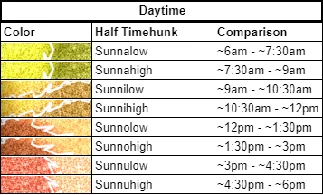
Vraki Day
- The Sun behaves similarly to our Sun.
- The day is divided into four sections, with each inner section divided into two (times are approximate due to seasons)
- Low vs High refers to the amount of Nari crystals ratio used in the mixture for each time chunk
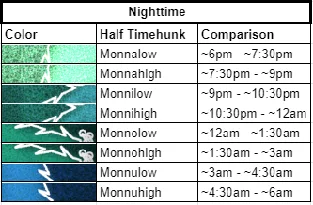
Vraki Night
- The moon is similar to Earth, except for its color.
- See Timekeeper for more information.
- The night sky uses the color palette in the Moon section. #61f878

- If you focus the moonlight on a smaller point, you can make any living being glow within its shine. More info on World Timeline.
- The night has a similar design to daytime.
- Low vs High refers to the ratio of Nari crystals used in the mixture for each time chunk.
Source: Legacy/Behind The Scenes/World Lore/World Map, Name, Vraki Calendar & UOM, etc.md
Vraki-Kalender & Geburtsalter
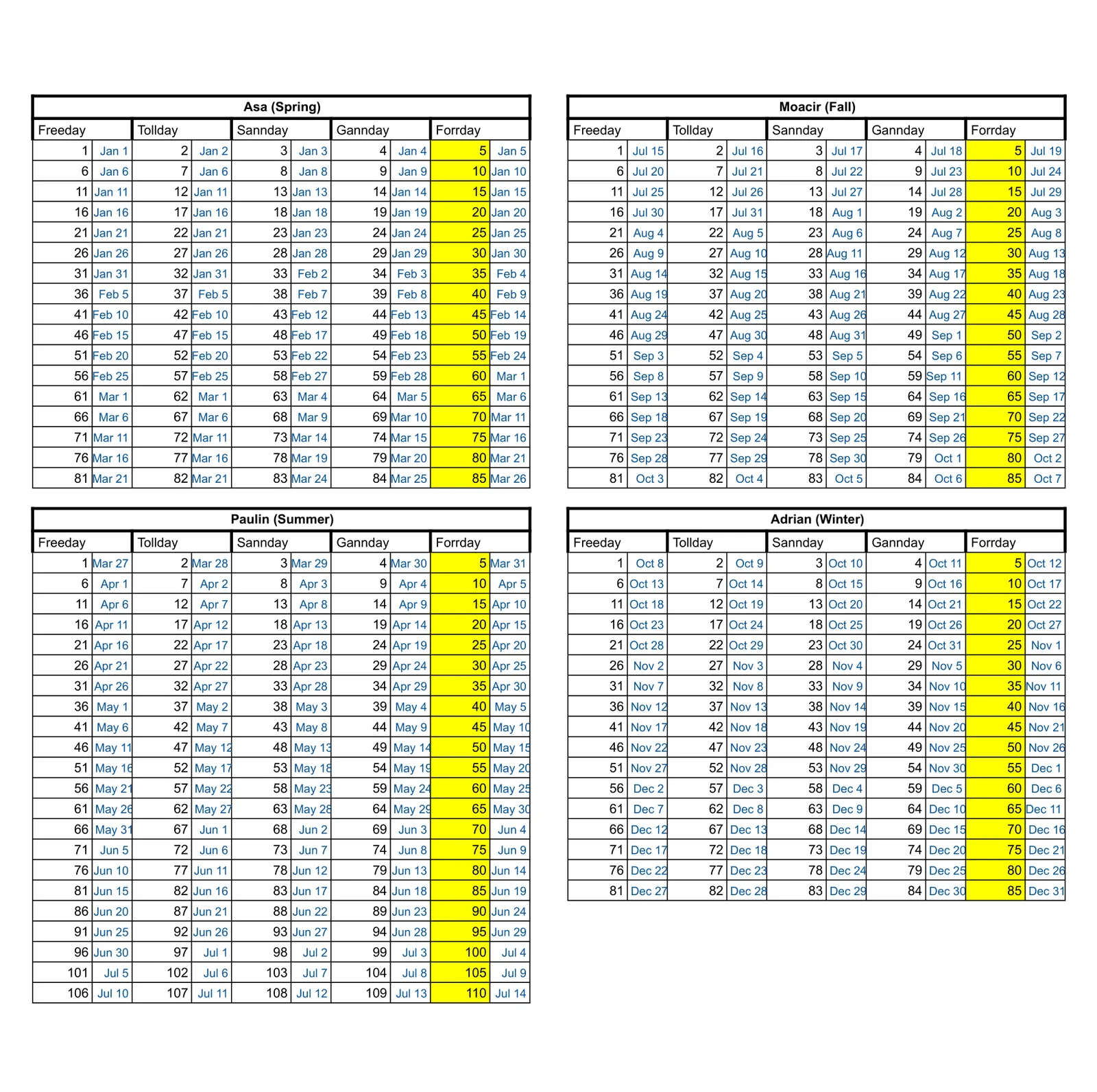
Der Vraki-Kalender wurde als offizieller Kalender eingeführt, als der Wohlstandsvertrag unterzeichnet wurde. Adrian, der die Vereinheitlichung der Maßeinheiten anführte, half auch bei der Schaffung eines einheitlichen Kalenders. Da er sich verewigen wollte, fand er einen Weg, das Jahr unter den Hofwissenschaftlern aufzuteilen, die den Wohlstandsvertrag geschaffen hatten.
Der Beginn des Kalenders wird durch den Fall von Ganyrami bestimmt; deshalb heißt diese neue Ära After Ganyrami (A.G.), und alles davor heißt Before Ganyrami (B.G.)
Jeder Wochentag ist nach einem der jeweiligen Königreiche benannt, wobei Forrday nach Forway benannt und zum Ende der Woche (Wochenende) erklärt wurde.
An jedem 1. Asa veröffentlicht Forway außerdem eine Mondkarte für Jäger, Bauern, Abenteurer und andere, die von den Mondphasen abhängen, um Umwelttendenzen abzuschätzen, für mickrige zwanzig Pearls.
*Eine Zuordnung zum gregorianischen Kalender ist in Blau zu sehen.
Öffentlicher Text: time-calendar.md
Hinter den Kulissen · vollständige Notizen
Vraki Calendar
- Created and standardized by ForWay City. See World Timeline for more information.
- On every Asa 1st, Forway also releases a lunar mapping for Hunters, farmers, adventurers, and others who depend on the lunar phases to gauge environmental tendencies for a measly twenty pearls.
- See the Isekai World Calendar for more information.
Year
- 4 Months
- 73 Weeks
- 365 Days
Month
- Named after the three courtroom scientists alongside the man who kickstarted the rebellion that led to the Prosperity Treaty (Freeish Paulin)
- Asa
- Represents Spring
- 85 Days
- 17 Weeks
- Paulin
- Represents Summer
- 110 Days
- 22 Weeks
- Moacir
- Represents Fall
- 85 Days
- 17 Weeks
- Adrian
- Represents Winter
- 85 Days
- 17 Weeks
Week
- Every week has 5 Days
- Freeday
- 1st day of the week.
- From Freeish Kingdom. They get the first day of the working week because they were where the rebellion began.
- Tollday
- 2nd day of the week.
- Work Day.
- Tolerideme was the second Kingdom to join.
- Sannday
- 3rd day of the week.
- Work Day.
- Sanbi was third.
- Gannday
- 4th day of the week.
- Work Day.
- Gandew Kingdom was the last kingdom to join.
- ForrDay
- 1st day of the week.
- Forward Day.
- A day when all embassies are closed to the public.
Birth Age
Age is the number of years a person has been alive as of the current year. Day/Month has no meaning to a person's age.
Source: Legacy/Behind The Scenes/World Lore/World Map, Name, Vraki Calendar & UOM, etc.md
Seasons
Hinter den Kulissen · vollständige Notizen
Average Temperature Table
| Δ0km | Δ2km | Δ4km | Δ6km | Δ8km | |
|---|---|---|---|---|---|
| Asa (Spring) | 20 ºC | 15 ºC | 10 ºC | 0 ºC | -10 ºC |
| Paulin (Summer) | 30 ºC | 25 ºC | 20 ºC | 10 ºC | 0 ºC |
| Moacir (Fall) | 15 ºC | 10 ºC | 5 ºC | -5 ºC | -15 ºC |
| Adrian (Winter) | 10 ºC | 5 ºC | 0 ºC | -10 ºC | -20 ºC |
Average Humidity Table
| Δ0km* | Δ2km | Δ4km | Δ6km | Δ8km | |
|---|---|---|---|---|---|
| Asa (Spring) | 85% | 75% | 65% | 50% | 40% |
| Paulin (Summer) | 90% | 80% | 70% | 55% | 45% |
| Moacir (Fall) | 85% | 75% | 65% | 50% | 40% |
| Adrian (Winter) | 75% | 65% | 55% | 40% | 30% |
*If close to water like Sanbi Kingdom. If not, treat like Δ1km
Source: Legacy/Behind The Scenes/World Lore/World Map, Name, Vraki Calendar & UOM, etc.md
Name Schema
Hinter den Kulissen · vollständige Notizen
Vier Königreiche
- To make names, contracts, and negotiations easier, Forway implemented a naming schema that began with any kingdom child born after the prosperity treaty came into effect in 671 A.G.
- NAME PLACE GUILD
- Given by parents at birth. Uniqueness and name characteristics vary by region.
- City of origin or main residence.
- City of origin or main residence.
- Often associated with where their primary guild is located.
- Guild Name. If participating in multiple guilds, then any of them.
- If the guild name is described as CITY-GUILD, and the city is the current place of the badge owner, then it is not written (e.g., Itagiba Sanbi Royal vs Itagiba Sanbi Sanbi-Royal)
- If not participating in any guild, this part of the name is skipped.
Source: Legacy/Behind The Scenes/World Lore/World Map, Name, Vraki Calendar & UOM, etc.md
Map
Hinter den Kulissen · vollständige Notizen
Isekai-Geschichte
- It is unknown how old the planet is, but it is estimated to be billions of years old.
Isekai Global Map
- The World Map created by the Four Kingdoms is located in the southern part of the planet.
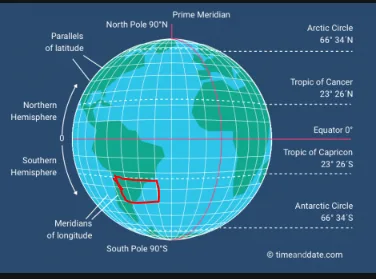
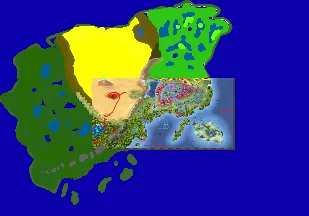
Vier Königreiche
- See the Four Kingdoms Map
Unknown Regions
- See Four Kingdoms Metadata Map
Source: Legacy/Behind The Scenes/World Lore/World Map, Name, Vraki Calendar & UOM, etc.md
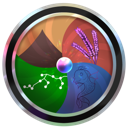
Time Keeper
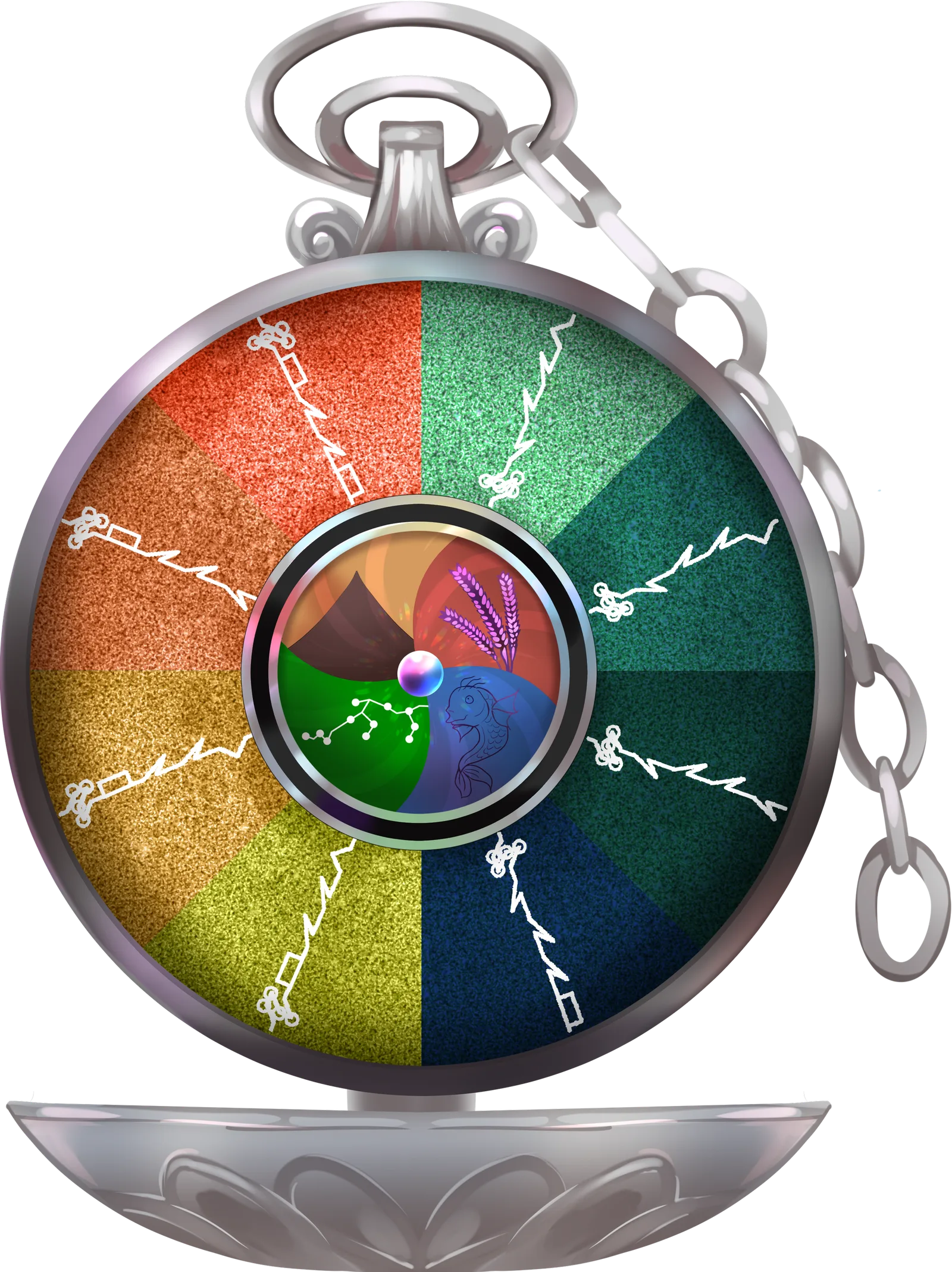
Ähnlich wie eine Sonnenuhr zeigt der Time Keeper die Tageszeit an, wenn man Sonnen- oder Mondlicht darauf scheinen lässt. Kurz darauf kannst du die Zeit daran ablesen, welcher Abschnitt biolumineszent zu leuchten beginnt.
Um den Time Keeper richtig abzulesen, beginne unten (6 Uhr), wo die Trennung zwischen dem gelben und dem marineblauen Abschnitt den Sonnenaufgang darstellt. Der gesamte gelbe Abschnitt ist Sunna, was einem timehunk entspricht, also etwa drei Stunden. Die Vraki-Schrift darin teilt den timehunk in halbe timehunks namens Sunnalow und Sunnahigh.
Im Uhrzeigersinn ab dem Anfang (6 Uhr) liest du die Zeit wie folgt ab:
Sunnalow, Sunnahigh, Sunnilow, Sunnihigh, Sunnolow, Sunnohigh, Sunnulow, Sunnuhigh.
Die Kante zwischen Rot und Hellgrün (12 Uhr) stellt den Sonnenuntergang dar, und wenn du im Uhrzeigersinn weiterliest, sind die halben timehunks:
Monnalow, Monnahigh, Monnilow, Monnihigh, Monnolow, Monnohigh, Monnulow, Monnuhigh.
Die Zeit lässt sich weiter in viertel, kleine und winzige timehunks unterteilen, aber dafür würde man einen Time Counter (ähnlich einer Sanduhr) benutzen, da man sich im Alltag oft so verabredet: „Treffen wir uns um Moonahigh für ein bisschen Spaß.“
Wie genau die Kulturen der Königreiche ihre Time Keepers im Blick behalten, ist sehr unterschiedlich. Das häufigste Beispiel ist, dass die Sanbianer selten pünktlich sind, während die Toleridemier unnötig pünktlich sind.
Öffentlicher Text: time-calendar.md
5 weitere Einträge auf dieser Seite gibt es nur unter .
Erstellt aus: Legacy/Public/time-calendar.md, Legacy/Behind The Scenes/World Lore/World Map, Name, Vraki Calendar & UOM, etc.md